
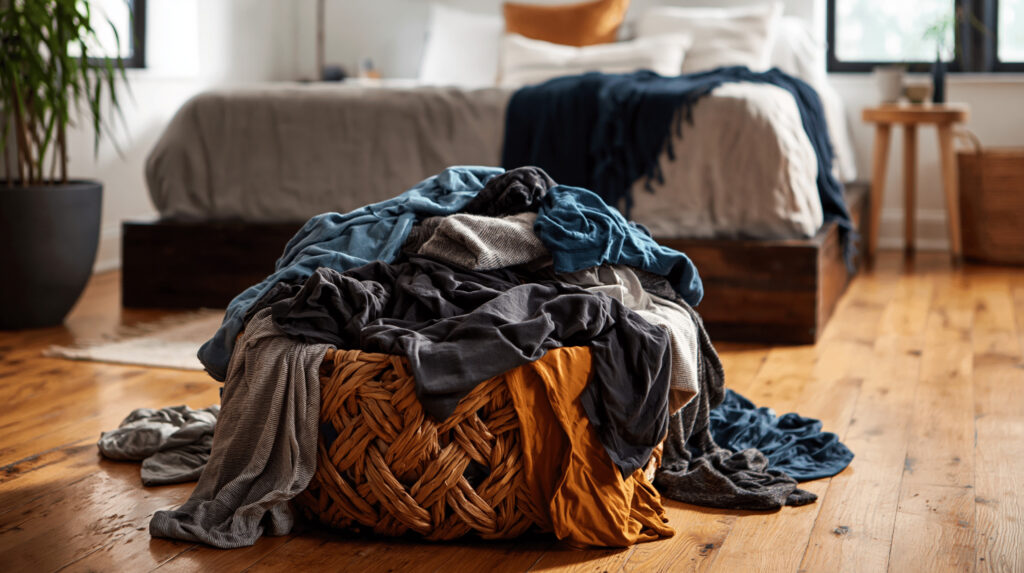
The Holiday Rush Is Here: A Laundry Survival Guide for Busy Families
There is a particular moment during the holiday season when the laundry seems to multiply overnight.
The children need clean clothes for school.
Someone needs a shirt for a work event.
Guests are arriving Friday.
The guest-room sheets haven’t been changed.
The table linens from Thanksgiving still need attention.
A suitcase has just returned full of dirty clothes.
There are sweaters draped over chairs.
Someone needs their holiday-party outfit.
And somehow, the hamper is full again.
Welcome to the holiday rush.
November and December can transform an ordinary household routine into a logistical challenge. You’re managing celebrations, shopping, cooking, work, school activities, travel, guests, family obligations—and the laundry doesn’t stop because the calendar is busy.
The solution isn’t necessarily to become more efficient at doing everything yourself.
Sometimes the better strategy is to decide what actually needs your time.
At A.W. Cleaners, we’ve spent more than 40 years helping local families care for the clothing and textiles that move through everyday life and special occasions.
Here’s a practical holiday laundry survival plan designed around one objective: make the season easier.
Rule #1: Stop Treating All Laundry as One Giant Task
“Do the laundry” sounds like one job.
It isn’t.
Laundry is actually a series of jobs: sorting, pretreating, washing, drying, folding, hanging, pressing, putting away, handling delicate garments, treating stains, managing linens, and caring for formalwear.
When everything gets mentally grouped into one enormous task, it feels impossible.
Instead, divide the workload into categories:
- Everyday Laundry: The clothing your household needs constantly.
- Professional Clothing: Dress shirts, trousers, blouses, uniforms, and other workwear.
- Special-care Garments: Pieces that require care based on their label, fiber, construction, embellishments, or finish.
- Holiday Clothing: Suits, dresses, sweaters, children’s special-occasion outfits, and other event garments.
- Household Textiles: Guest bedding, table linens, blankets, and appropriate washable household items.
Once the categories are visible, you can decide what to handle yourself—and what may make sense to outsource.
Rule #2: Prioritize What You Need Next
A full hamper creates the illusion that everything is equally urgent. It isn’t. Ask one question: “What does the household need during the next three days?”
School clothes?
Work shirts?
Children’s uniforms?
An outfit for Saturday’s party?
Guest bedding?
Start there.
Holiday laundry becomes more manageable when you stop trying to conquer the entire backlog at once.
Rule #3: Create a “Do Not Wash” Zone
One of the easiest ways to damage a special garment during a busy week is to let it disappear into the ordinary laundry.
That wool sweater.
A delicate blouse.
A sequined holiday top.
A suit trouser.
A special dress.
A child’s formal outfit.
Create a separate place for garments that need their care labels checked or require professional evaluation.
It might be a basket.
A garment bag.
A section of the closet.
The important thing is that nobody accidentally tosses the item into a normal wash-and-dry cycle.
Rule #4: Give Every Family Member a Job
If several people create laundry, one person doesn’t necessarily need to manage every part of it.
Age-appropriate responsibilities can include:
- Putting dirty clothes in the hamper.
- Emptying pockets.
- Separating towels.
- Pairing socks.
- Folding simple garments.
- Taking clean clothes to bedrooms.
- Putting clothing away.
- Preparing school uniforms for the next day.
The objective isn’t a perfect household system.
It’s reducing the number of tiny tasks being carried by one person.
During the holiday season, that matters.
Rule #5: Empty the Pockets
This deserves its own rule because holiday pockets are dangerous places. They hold receipts, candy, lip balm, tissues, pens, gum, crayons, coins, small toys, and event tickets.
Before clothing enters the laundry, check the pockets.
A few seconds can prevent a much larger problem.
Better yet, make pocket-emptying the wearer’s responsibility before clothing reaches the hamper.
Rule #6: Treat Stains as Information
A stain doesn’t simply need cleaning.
It needs identification.
What happened?
Wine?
Oil?
Chocolate?
Coffee?
Makeup?
Gravy?
Mud?
The substance can matter when determining appropriate care.
If you’re sending a garment for professional cleaning, remember what caused the stain when possible.
And if you’ve already tried treating it, mention that, too.
Many stains can often be improved or removed, but results depend on the stain, textile, age, and previous treatment.
Rule #7: Don’t Let the Dryer Make Decisions for You
The dryer is convenient.
It is not appropriate for every garment or every situation.
Before drying an unfamiliar, delicate, stained, or special garment, check the care instructions.
Heat can affect some fibers, finishes, garment shapes, and stains.
During busy periods, slowing down for 15 seconds to read the label can be considerably faster than trying to rescue a damaged garment later.
Rule #8: Build a Workweek Clothing Buffer
Professional clothing can create its own holiday bottleneck.
If you need dress shirts, blouses, trousers, or other business attire during the week, don’t wait until Sunday night to discover everything needs attention.
Try to maintain a small buffer of work-ready clothing. That might mean:
- Five prepared shirts.
- Several clean blouses.
- Two pairs of ready-to-wear trousers.
- A blazer that’s clean and presentable.
- The exact number depends on your wardrobe and schedule.
The principle is simple: Don’t let tomorrow’s clothing depend entirely on tonight’s laundry.
Rule #9: Give Holiday Outfits Their Own Section
By late November, you probably know at least some of the events on your December calendar.
Take the clothes you’ll need and create an event-ready section:
- Holiday dress
- Suit
- Blazer
- Sweaters
- Children’s outfits
- Party clothing
- Christmas attire
- New Year’s options
Inspect everything now.
Once each garment is ready, return it to that designated section.
Then resist borrowing from it for ordinary wear unless necessary.
You’re essentially creating a small reserve of clean, event-ready clothing.
Rule #10: Prepare Guest Bedding Before Guests Arrive
Nothing makes holiday laundry feel more overwhelming than trying to prepare an entire house the night before company arrives.
If guests are coming, identify what you’ll need ahead of time: sheets, pillowcases, blankets, comforters or appropriate bedding, and guest towels.
Wash or professionally care for appropriate items in advance rather than waiting until the guest room is needed.
Then keep the prepared bedding together.
When arrival day comes, you’re making the bed—not beginning a laundry marathon.
Rule #11: Don’t Mix Holiday Table Linens into the Everyday Pile
Holiday tablecloths and cloth napkins deserve an inspection before they’re treated like ordinary household laundry. They may contain grease, wine, coffee, cranberry sauce, candle wax, gravy, chocolate, or makeup.
Some may also be made from delicate, decorative, or heirloom fabrics.
Check care labels and stain locations before choosing a cleaning method.
And don’t put stained holiday linens back into storage simply because the stains aren’t immediately obvious.
Rule #12: Rewear Wisely
Not every garment needs to be cleaned after every brief wear.
A sweater worn for two hours over another layer may not need the same care as a shirt worn directly against the skin all day.
A jacket may be suitable for another wear if it’s clean, fresh, and unstained.
Evaluate garments individually.
Appropriate rewearing can reduce unnecessary laundry while also reducing repeated cleaning and wear on fabrics.
But if a garment has perspiration, food, odor, visible soil, or a stain, address it appropriately rather than simply returning it to the closet.
Rule #13: Use the “One Load Ahead” Strategy
Instead of waiting for the laundry to become an emergency, try staying one essential load ahead.
If tomorrow’s school clothes are ready, prepare the next category.
If work clothes are ready, move to towels.
If towels are ready, handle the children’s clothing.
You don’t need to finish everything.
You simply need to prevent the household from reaching zero.
That small shift turns laundry from crisis management into maintenance.
Rule #14: Stop Folding Things That Don’t Need Folding
Not every textile requires elaborate folding.
Socks do not need to look like they belong in a department-store display.
Pajamas don’t need precision.
Children’s play clothes don’t need perfect creases.
Holiday survival is about functional systems.
Save the extra attention for garments that actually benefit from careful folding, hanging, or professional finishing.
Rule #15: Create a “Clean but Not Put Away” Limit
Sometimes washing isn’t the problem.
Putting everything away is.
A chair becomes a clean-clothes mountain.
Then someone needs one shirt from the bottom.
Ten minutes later, the entire pile is unfolded again.
Set a simple rule: Clean laundry should have a temporary landing place, but it can’t live there indefinitely.
Even a basic system of separate baskets by family member can make putting clothing away easier.
Rule #16: Don’t Iron at Midnight If You Don’t Have To
The holiday season is filled with tasks that appear at inconvenient times.
Pressing tomorrow’s shirt at 11:45 p.m. doesn’t have to become one of them.
If several shirts, trousers, dresses, or other appropriate garments need professional finishing, consider handling them as a group ahead of time.
Your future self may appreciate the decision.
Rule #17: Protect Your Most Valuable Resource: Time
We often evaluate laundry in terms of money.
Detergent costs this much.
A washer uses this much electricity.
Professional cleaning costs that much.
But holiday decisions should also account for time.
If laundry consumes several hours you desperately need for family, work, rest, shopping, cooking, travel preparation, hosting, or community activities, then the true cost of doing everything yourself isn’t just water and detergent.
It’s your attention.
Rule #18: Decide What Is Worth Outsourcing
Outsourcing doesn’t have to mean sending out every textile in the house.
Think strategically.
Perhaps you handle everyday children’s clothing but outsource appropriate wash-and-fold laundry if that service is available.
Perhaps you wash everyday clothes but send dress shirts for professional laundering and pressing.
Perhaps you handle sheets but have bulky or specialty bedding professionally cared for when appropriate.
Perhaps formalwear, delicate garments, and stain treatment always go to a professional.
The right system depends on your household.
The point is to remove the tasks that create the greatest burden or require expertise you don’t have.
Rule #19: Create a Holiday Laundry Drop Zone
Designate one location for anything that needs outside attention.
When you find a stained dress, a suit needing care, a pile of shirts, a special sweater, a tablecloth, or a garment needing repair, put it there.
Once the pile reaches a reasonable point—or an upcoming event makes something urgent—handle it together.
This eliminates the “I meant to take that” problem.
Rule #20: Don’t Sacrifice Sleep to the Hamper
This may be the most important rule.
There will always be more laundry.
There will not always be another holiday season exactly like this one.
If the choice is between folding towels at midnight and getting enough sleep before tomorrow’s family gathering, the towels can wait.
A useful household system should support your life.
It shouldn’t consume it.
The Holiday Laundry Survival Checklist
When the season becomes overwhelming, return to this simple checklist:
1. What do we need in the next three days?
2. What needs special care?
3. What can wait?
4. What can another family member handle?
5. What can be reworn appropriately?
6. What should be professionally cleaned or pressed?
7. What could be outsourced to save meaningful time?
You don’t need to win at laundry. You need clean clothes and enough time left to enjoy December.
When Professional Laundry and Garment Care Can Help
Professional service may be especially useful during the holiday season for dress shirts, suits, dresses, formalwear, delicate sweaters, stain treatment, special-occasion clothing, or appropriate household textiles.
Other garments whose labels, construction, or condition call for specialized care.
And where convenient laundry or pickup-and-delivery options are available, outsourcing appropriate everyday items may help reduce household workload even further.
Contact A.W. Cleaners to confirm which services best fit your family’s specific needs.
Why Families Trust A.W. Cleaners
For more than 40 years, A.W. Cleaners has helped families throughout Baltimore County and Carroll County care for the clothing and textiles that move through their lives.
We know laundry isn’t the most important thing you’ll do this holiday season.
That’s precisely the point.
Professional garment care can give you back a little time for the things that are.
Celebrate More. Manage Laundry Less.
The holidays aren’t supposed to be a month-long household efficiency contest.
They’re supposed to be lived.
Gather around the table.
Go to the concert.
Visit the relatives.
Attend the party.
Watch the movie with the kids.
Rest.
Laugh.
Stay longer than you planned.
The laundry will still be there.
And you don’t necessarily have to handle all of it yourself.
Holiday laundry piling up?
Bring your professional clothing, special-occasion garments, shirts, sweaters, stained items, and appropriate household textiles to A.W. Cleaners for the professional care they need.
And contact us to discuss available laundry and convenience options that may help lighten your household workload during the holiday rush.
Frequently Asked Questions
How can I keep holiday laundry from becoming overwhelming?
Prioritize clothing needed during the next few days, separate special-care garments from ordinary laundry, share age-appropriate tasks among household members, and consider outsourcing the categories that consume the most time or require professional expertise.
Does every garment need to be cleaned after one wear?
No. Appropriate cleaning frequency depends on the garment, fabric, how long it was worn, whether it contacted the skin, and whether it has stains, odor, perspiration, or visible soil. Follow care instructions and evaluate garments individually.
Why do shirts usually need more frequent laundering than jackets?
Shirts typically sit directly against the skin, exposing them to perspiration, body oils, deodorant, and other soil. Jackets are often worn over other layers and may not require cleaning at the same frequency.
Should I put stained clothing in the dryer?
Check the garment’s care instructions and address the stain appropriately before applying heat. Heat can make some stains more difficult to treat.
What holiday clothing should be professionally cleaned?
That depends on the care label, fabric, construction, staining, and condition. Suits, formalwear, certain dresses, delicate sweaters, embellished garments, and other specialty pieces may benefit from professional evaluation.
Can professional laundry service save time during the holidays?
For some households, yes. The value comes not only from the washing itself but also from reducing time spent sorting, processing, drying, folding, pressing, and managing the household laundry cycle. Contact A.W. Cleaners to discuss available service options.
Should I clean guest bedding ahead of time?
Yes. Preparing appropriate bedding before guests arrive prevents it from becoming another last-minute task. Follow the care instructions for comforters, blankets, and other specialty bedding.
Does A.W. Cleaners offer pickup and delivery? If pickup and delivery is currently available in your area, it can further reduce the time required for garment and laundry care. Contact A.W. Cleaners for current service availability and coverage.